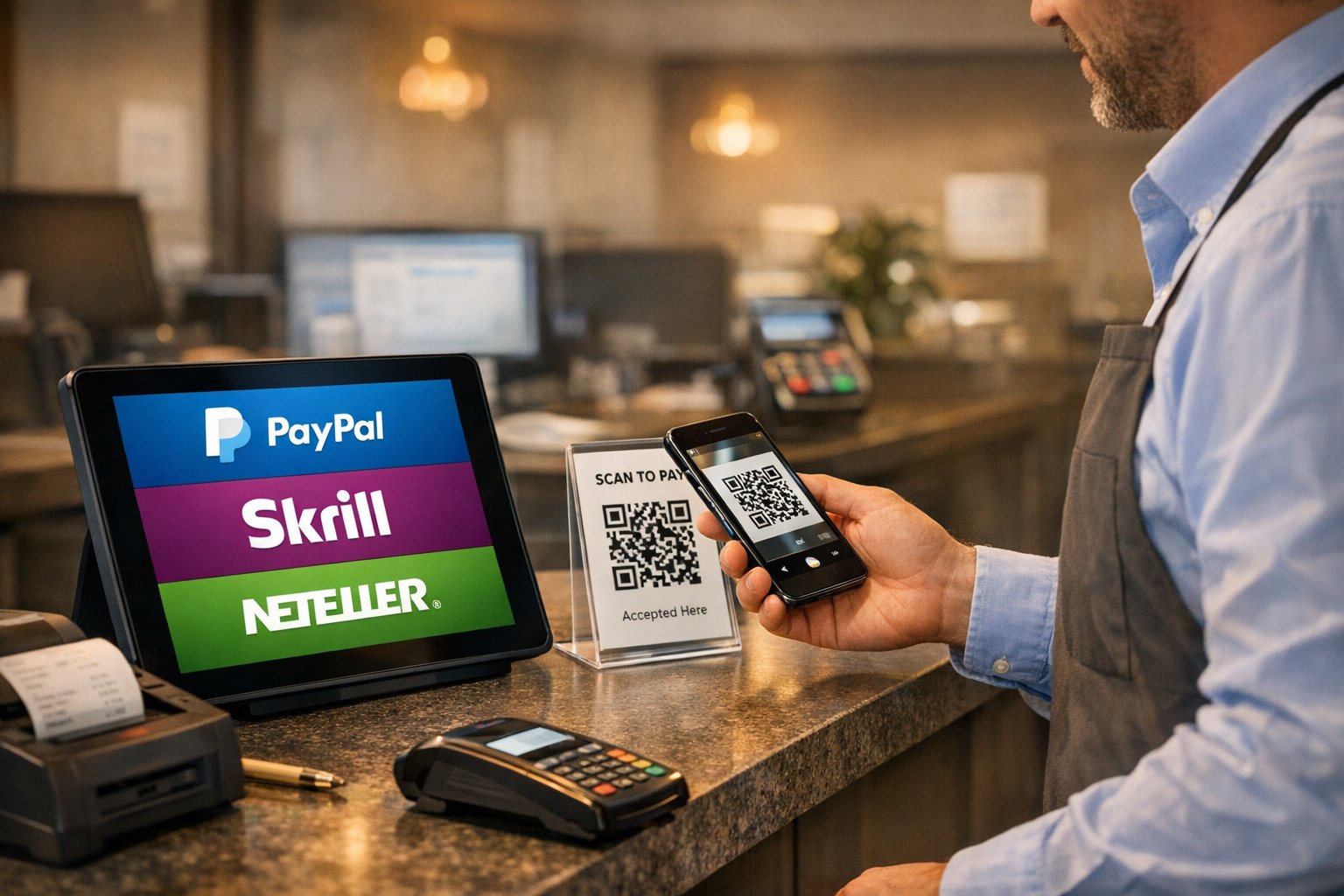
Digital wallets — commonly called e-wallets — have become one of the most popular payment methods worldwide. Platforms like PayPal, Skrill, and Neteller give consumers a fast, secure way to pay online without entering credit card details on every transaction. For merchants, accepting e-wallet payments can unlock new customer segments, reduce cart abandonment, and lower transaction costs compared to traditional card processing.
But integrating e-wallets into a merchant account is not as simple as adding a button to your checkout page. Each e-wallet has different integration models, fee structures, settlement timelines, and geographic limitations. For high-risk merchants, the complexity increases further because many e-wallet providers treat high-risk industries differently from standard businesses.
This guide provides a comprehensive comparison of PayPal, Skrill, and Neteller for merchant account integration. We cover the technical integration process, fee structures, settlement terms, use cases, and the specific considerations for high-risk merchants who want to offer e-wallet payment options.
The E-Wallet Landscape in 2026
E-wallets are no longer a niche payment method. According to industry data, digital wallet transactions surpassed $16 trillion globally in 2025, representing over 30% of all e-commerce transaction value. PayPal alone has over 430 million active accounts worldwide, while Skrill and Neteller together serve more than 50 million users concentrated in Europe, Asia, and emerging markets.
For merchants in high-risk industries, e-wallets offer several advantages over traditional card processing:
- Lower chargeback risk. E-wallet transactions are authenticated by the wallet provider, which reduces the likelihood of friendly fraud and unauthorized transaction disputes. PayPal's Seller Protection, for example, covers eligible transactions against chargebacks and reversals.
- Faster access to funds. Many e-wallets offer instant or same-day settlement options, which is critical for high-risk merchants who may face rolling reserves with traditional processors.
- Geographic reach. Skrill and Neteller are particularly strong in markets where credit card penetration is low but digital wallet adoption is high, such as Southeast Asia, Eastern Europe, and parts of Africa.
- Higher approval rates. E-wallet transactions bypass traditional card network risk scoring, which can result in higher approval rates for businesses in gray-area industries.
However, e-wallet integration also comes with trade-offs. E-wallet fees are generally higher than card processing fees for high-volume merchants, and each e-wallet platform has its own prohibition list that may overlap with or differ from traditional processor restrictions.
PayPal: The Industry Standard
PayPal is the most widely recognized e-wallet brand globally. For merchants, PayPal offers several integration options: PayPal Checkout (the standard button), PayPal Payments Pro (a hosted checkout with a monthly fee), and PayPal Payflow Gateway (for businesses that need a full payment gateway).
PayPal Fees
- Standard PayPal Checkout: 2.99% + $0.49 per transaction (U.S.)
- PayPal Payments Pro: $30/month + 2.99% + $0.49 per transaction
- PayPal Payflow Gateway: $10/month + $0.10 per transaction (separate from processing fees)
- Micropayments: 4.99% + $0.09 for transactions under $10
- International transactions: Additional 1.5% currency conversion fee
- Chargeback fee: $20 per disputed transaction (waived if Seller Protection applies)
PayPal Settlement
PayPal typically settles funds within 1–2 business days for verified accounts. Instant transfer to a linked bank account or debit card is available for a fee of 1.75% (minimum $0.25, maximum $25). PayPal holds funds for 21 days on new accounts or accounts with higher risk profiles, though this can be lifted after establishing a processing history.
PayPal for High-Risk Merchants
PayPal is notoriously restrictive with high-risk industries. Prohibited categories include: CBD and hemp products, firearms and ammunition, gambling and gaming (except in regulated jurisdictions with pre-approval), adult content, pharmaceutical sales, and tobacco products. PayPal actively scans merchant websites and transaction patterns for prohibited activity. Accounts found processing in restricted categories are subject to immediate holds, reserve requirements, or permanent limitation with a 180-day fund hold period.
For merchants in permitted industries, PayPal offers a relatively straightforward integration. PayPal Checkout works with most major e-commerce platforms including Shopify, WooCommerce, Magento, and BigCommerce through pre-built plugins. PayPal's REST API allows custom integrations for businesses with unique checkout flows.
When to Use PayPal
- Your business processes under $50,000 per month in a low-risk category
- Your customer base is primarily in North America or Western Europe
- You want a quick, low-effort integration with an established brand
- You value PayPal's Seller Protection for eligible transactions
- You need recurring billing or subscription support (PayPal Reference Transactions)
When to Avoid PayPal
- Your business is in a gray-area or high-risk industry
- You process over $100,000 per month and need negotiable rates
- Your customers are primarily in emerging markets where PayPal adoption is lower
- You have been terminated by PayPal or placed on the MATCH list
- You need instant settlement for cash flow management
Skrill: The Cross-Border Specialist
Skrill (formerly Moneybookers) is a UK-based digital wallet widely used in Europe, the Middle East, Africa, and Asia. Unlike PayPal, which positions itself as a universal payment solution, Skrill has deliberately focused on cross-border payments, online gambling, forex trading, and emerging-market merchants. This focus makes Skrill a more viable option for certain high-risk categories.
Skrill Fees
- Merchant transaction fee: 2.50% + $0.30 per transaction (standard rate; negotiable for high volume)
- Skrill Quick Checkout: 2.50% + $0.30 (hosted checkout solution)
- Skrill Payment Gateway: Custom pricing for high-volume merchants (typically 1.5–2.5% + fixed fee)
- Currency conversion: 3.99% above the mid-market rate (one of the higher conversion fees in the industry)
- Instant transfer to bank: 1.45% fee (minimum $0.50, no maximum specified)
- Skrill Prepaid Mastercard: Withdrawals at ATMs worldwide with variable fees
- Chargeback fee: $35 per disputed transaction
- Inactivity fee: $5/month after 12 months of no login activity
Skrill Settlement
Skrill offers same-day settlement for a fee, or standard 1–2 business day settlement at no additional cost. Skrill to Skrill transfers are instant. Withdrawals to bank accounts typically process within 1–3 business days depending on the destination country. Skrill Instant Bank Transfer is available in 30+ countries with funds arriving in minutes.
Skrill for High-Risk Merchants
Skrill is significantly more permissive than PayPal when it comes to high-risk industries. Skrill openly supports online gambling and gaming merchants where legally permitted, forex and binary options trading (subject to regulation), and adult entertainment in certain jurisdictions. Skrill also processes for cryptocurrency exchanges, forex brokers, and travel booking platforms.
However, Skrill does have restrictions. CBD and hemp products are not supported. Skrill also prohibits firearms, ammunition, and certain pharmaceutical categories. Merchants in restricted categories may still have their accounts closed with funds held temporarily.
Skrill's integration options include a hosted checkout (Skrill Quick Checkout), a full API for custom integrations, and a payment gateway for high-volume merchants. Skrill supports 40+ currencies and 200+ payment methods globally, including local bank transfers in many countries.
When to Use Skrill
- Your business operates in online gambling, gaming, forex, or adult entertainment
- Your customer base is in Europe, the Middle East, Africa, or Asia
- You need multi-currency support with local payment methods
- You have been declined by PayPal for high-risk industry concerns
- You want to offer customers an alternative to credit card funding
When to Avoid Skrill
- Your business is in CBD, hemp, firearms, or pharmaceuticals
- Your customers are primarily in North America (PayPal is more widely adopted)
- You need low currency conversion costs (Skrill's 3.99% is among the highest)
- You want low transaction costs for high-volume processing
Neteller: The Real-Time Settlement Leader
Neteller, like Skrill, is part of the Paysafe Group and shares much of the same infrastructure. However, Neteller is positioned differently in the market. While Skrill targets merchant acceptance broadly, Neteller focuses on person-to-person transfers, online gaming payouts, and high-speed settlement. Neteller is particularly popular among affiliates, freelancers, and businesses that need to move money quickly across borders.
Neteller Fees
- Merchant transaction fee: 2.75% + $0.25 per transaction (similar to Skrill's pricing)
- Neteller VIP program: Tiered rates for high-volume merchants (fees decrease at higher tiers)
- Currency conversion: 3.99% above the mid-market rate (identical to Skrill)
- Instant transfer to bank: 1.75% fee (minimum $1.00)
- Neteller Instant: Real-time transfers between Neteller accounts at no cost
- Neteller+ Prepaid Card: ATM withdrawal fees apply (varies by country)
- Chargeback fee: $35 per dispute
- Inactivity fee: $5/month after 12 months of inactivity
Neteller Settlement
Neteller's primary differentiator is settlement speed. Neteller to Neteller transfers are instant and free. Business account withdrawals can be made to bank accounts in 1–2 business days, or instantly to a Neteller+ prepaid card. Neteller VIP members receive priority processing and faster settlement times. Neteller also offers same-day settlement for merchant transactions when using Neteller's Rapid Transfer service.
Neteller for High-Risk Merchants
Neteller's industry restrictions closely mirror Skrill's. Supported high-risk categories include online gambling (where legally permitted), forex trading, binary options, and adult entertainment. Neteller is widely used by iGaming operators for both deposits and withdrawals, making it a critical payment rail for that industry.
Neteller is also popular with affiliate marketers and digital freelancers who need to receive payments from overseas clients. The instant settlement feature and prepaid card make it easy to access funds without waiting for traditional bank transfer timelines.
Merchant integration is available via the Neteller API, which supports both hosted checkout and direct integration models. Neteller's API documentation is comprehensive for standard payment flows but may require dedicated development support for complex use cases like split payments, mass payouts, or recurring billing.
When to Use Neteller
- Your business needs instant or same-day settlement access
- You operate in iGaming, forex, or affiliate marketing
- You need to make mass payouts to users or affiliates
- Your customers expect real-time payment confirmation
- You want a combined processing + payout solution
When to Avoid Neteller
- Your customers are primarily retail consumers in North America
- You need low-cost currency conversion for high-volume international sales
- Your business is in a category not supported by Paysafe's risk policies
- You need a simple e-commerce checkout with minimal integration work
Side-by-Side Comparison
The table below summarizes the key differences between PayPal, Skrill, and Neteller for merchant account integration:
Transaction fees (standard): PayPal 2.99% + $0.49, Skrill 2.50% + $0.30, Neteller 2.75% + $0.25
Monthly fee (optional): PayPal $30 (Payments Pro), Skrill $0, Neteller $0
Currency conversion: PayPal 2.5% (plus wholesale rate spread), Skrill 3.99% above mid-market, Neteller 3.99% above mid-market
Settlement: PayPal 1–2 days (instant at 1.75% fee), Skrill 1–2 days (same-day available), Neteller instant (Neteller to Neteller)
Chargeback fee: PayPal $20, Skrill $35, Neteller $35
High-risk support: PayPal Limited/none, Skrill Moderate (gambling, forex, adult), Neteller Moderate (gambling, forex, adult)
Global reach: PayPal 200+ countries/25 currencies, Skrill 200+ countries/40+ currencies, Neteller 200+ countries/26 currencies
Recurring billing: PayPal Yes (Reference Transactions), Skrill Limited (API-based), Neteller Limited (API-based)
Instant payout: PayPal Yes (1.75% fee), Skrill Yes (1.45% fee), Neteller Yes (instant between accounts)
Technical Integration Options
All three e-wallets offer multiple integration paths depending on your technical capability and business requirements.
Hosted Checkout (Easiest)
Both PayPal (PayPal Checkout), Skrill (Quick Checkout), and Neteller offer hosted checkout solutions. Customers are redirected to the e-wallet's payment page, complete the transaction, and are returned to your confirmation page. This is the simplest integration path and works with most e-commerce platforms through pre-built plugins. Hosted checkout minimizes PCI compliance scope because credit card data never touches your server.
API Integration (Most Flexible)
All three providers offer REST APIs for custom integration. PayPal's API is the most mature and well-documented, with extensive SDKs for JavaScript, Python, PHP, Ruby, Java, and .NET. Skrill's API is functional but less polished, with documentation focused primarily on the hosted checkout flow. Neteller's API is similar to Skrill's, with comprehensive endpoints for payment processing and mass payouts.
Payment Gateway Integration
For merchants processing high volumes, PayPal offers Payflow Gateway ($10/month + $0.10/transaction), which allows you to accept credit cards and PayPal in a single integration. Skrill and Neteller offer custom gateway pricing for high-volume merchants, typically requiring a direct relationship with Paysafe's sales team.
Multi-Wallet Strategy
Many successful high-risk merchants use a multi-wallet strategy, offering two or three e-wallet options at checkout. This approach maximizes conversion by giving customers their preferred payment method. Common combinations include:
- PayPal + Skrill: Covers North America (PayPal) and Europe/emerging markets (Skrill) with minimal overlap
- Skrill + Neteller: Ideal for iGaming and forex, where both wallets are widely adopted by users
- PayPal + Neteller: For businesses with both retail consumers (PayPal) and affiliate/partner payouts (Neteller)
E-Wallet Integration for High-Risk Merchants
High-risk merchants face unique challenges when integrating e-wallets. Here are the most important considerations:
Underwriting and Approval
All three e-wallet providers underwrite merchant accounts based on industry, processing volume, chargeback history, and business model. PayPal is the most restrictive and will decline or limit accounts in most high-risk categories. Skrill and Neteller are more permissive but still require detailed documentation: business license, proof of business address, processing history, website URL, product descriptions, and ownership identification.
Approval timelines vary. PayPal typically processes applications within 1–3 business days. Skrill and Neteller can take 3–7 business days for high-risk applications, and may require additional compliance documentation depending on your industry and geographic market.
Rolling Reserves
E-wallets rarely require rolling reserves in the same way that traditional high-risk merchant accounts do. However, PayPal may place reserves on accounts in higher-risk categories, and Skrill/Neteller may hold funds temporarily during the first 30–90 days of processing. These holds are typically transparent and disclosed during underwriting.
Integration with Traditional Merchant Accounts
The most effective setup for high-risk merchants is often a hybrid approach: a dedicated high-risk merchant account for credit card processing plus one or more e-wallet integrations for digital wallet payments. This combination maximizes approval rates while minimizing the risk of losing all payment processing capability if one provider restricts your account.
Implementation requires a payment orchestrator or gateway that can route transactions to multiple processors. Some payment gateways like Nuvei, Worldpay, and Checkout.com support multi-processor routing out of the box, while others require custom development. WebPayMe partners with gateways that support this hybrid model, ensuring that high-risk merchants can offer both card and e-wallet payments through a single integration.
E-Wallet Settlement Speed Comparison
Settlement speed can significantly impact cash flow, especially for high-risk merchants who may already face rolling reserves from their primary processor. Here is how the three e-wallets compare:
PayPal: Standard settlement to bank in 1–2 business days. Instant transfer available at 1.75% fee (min $0.25, max $25). PayPal Business Debit Mastercard provides instant access to funds for a 1.5% fee (capped at $15). Limited same-day settlement options.
Skrill: Standard settlement in 1–2 business days. Same-day settlement available for a fee in most European markets. Skrill to Skrill transfers are instant. Skrill Instant Bank Transfer provides real-time settlement in 30+ countries.
Neteller: Neteller to Neteller transfers are instant and free. Standard bank withdrawal in 1–2 business days. Neteller+ Prepaid Mastercard provides instant ATM access to funds. VIP members receive priority settlement.
For merchants who need real-time access to funds, Neteller's instant transfer capability is the strongest option, followed by Skrill's same-day settlement. PayPal's instant transfer service is convenient but expensive for frequent use.
Key Takeaways
E-wallet integration is a powerful tool for merchants of all sizes, but particularly for high-risk businesses that need to diversify their payment options and reduce dependence on any single processor. Here is what to remember:
- PayPal is best for low-risk merchants with a North American or European customer base who need a quick, trusted checkout option. Avoid PayPal if you are in a restricted industry.
- Skrill is the cross-border specialist for merchants serving emerging markets, particularly in iGaming, forex, and adult entertainment. Higher currency conversion fees are the main trade-off.
- Neteller leads on settlement speed with instant transfers between Neteller accounts and a prepaid card for immediate fund access. Best for iGaming, affiliate payouts, and businesses that need real-time settlement.
- A multi-wallet strategy combining two or three e-wallets maximizes conversion rates and provides redundancy. Pair with a dedicated high-risk merchant account for comprehensive payment coverage.
- Technical integration ranges from one-click hosted checkout (easiest) to full API integration (most flexible). Choose based on your development resources and business requirements.
E-wallets are not a replacement for a dedicated merchant account, but they are an essential complement. For high-risk merchants, offering PayPal, Skrill, or Neteller at checkout can increase conversion rates by 5–15% compared to card-only checkout — and with settlement times that often beat traditional processors, the cash flow benefits are significant.
Ready to add e-wallet payments to your merchant setup? Contact WebPayMe for a free consultation on integrating PayPal, Skrill, Neteller, and other digital wallets into your payment infrastructure.